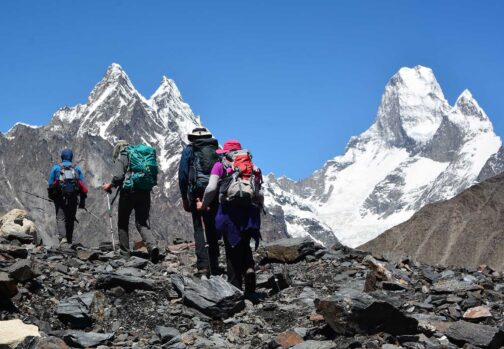
Ama Dablam does not announce itself with height alone. At 6,812 meters, it is not the tallest mountain in the Khumbu. Yet when climbers walk through Everest Base Camp or gaze up from Pangboche, it is Ama Dablam that captures their attention. Its sharp ridges, towering granite walls, and dramatic summit pyramid create a presence that feels more alpine than Himalayan.
This is a mountain that does not invite casual ambition. It demands precision, composure, and technical skill. That is why experienced alpinists quietly refer to Ama Dablam as the Himalaya’s most honest test. It does not let you hide behind altitude. It exposes exactly how well you climb.
Many Himalayan peaks allow climbers to follow long snow slopes toward a broad summit. Ama Dablam is different. From the moment you leave Base Camp, the route pushes you into steeper terrain, sharper ridges, and more complex movement. The mountain rises as a narrow pyramid rather than a wide dome, forcing climbers onto exposed faces of rock, ice, and snow.
This constant exposure is what gives Ama Dablam its legendary status. You are never simply walking upward. You are climbing, balancing, and making deliberate decisions at every step. In alpine grading terms, the route is rated TD/5, which means very difficult. In practical terms, it means the mountain requires full alpine competence.
The first major technical barrier on Ama Dablam is the Yellow Tower. This section is a near-vertical granite wall that must be climbed to reach Camp 2. By the time climbers arrive here, they have already spent days moving through high altitude terrain. Their legs are tired, their breathing is heavier, and the air is thin.
The Yellow Tower changes the rhythm of the climb. Instead of walking, climbers must use their hands and feet to pull themselves upward on steep rock, relying on fixed ropes and careful foot placement. It is here that the mountain begins to feel truly alpine. Technique, not just stamina, determines progress.
Above Camp 2 lies one of the most dramatic features of the route: the Mushroom Ridge. This narrow crest of ice and snow connects Camp 2 to Camp 3 and is flanked by enormous drops on both sides. The exposure here is profound. Hundreds of meters of air fall away beneath your boots, and the ridge itself is often narrow and wind-scoured.
Crossing Mushroom Ridge requires calm focus. There is no space for hesitation or distraction. Each step must be deliberate, and every movement must be secure. This is the point where many climbers realize what Ama Dablam truly represents. It is not just physically demanding. It is mentally intense.
Ama Dablam is a mixed climb, meaning the terrain constantly shifts between rock, ice, and snow. A climber may move from granite slabs to frozen waterfalls and then onto narrow snow ridges within the same hour. There is no single style of movement that dominates. The mountain demands versatility.
This constant transition is part of what makes the climb so engaging and so difficult. It requires climbers to stay mentally present and technically sharp from start to finish. Complacency has no place here.
From Camp 3, the route rises steeply toward the summit in a sharp pyramid of snow, ice, and rock. The slopes are typically between 55 and 65 degrees, and the exposure increases with every meter gained. The air is thin, the temperature is cold, and fatigue weighs heavily on the body.
Yet this final section is also where the mountain reveals its beauty most clearly. The line to the summit is elegant and direct, cutting up through the sky toward a small, exposed crest. Reaching that crest means completing one of the most refined alpine climbs in the Himalaya.
Ama Dablam has a short and precise climbing window. The most reliable season is from September to November, when the monsoon has cleared and weather patterns become more stable. During this period, snow and ice conditions tend to be safer, and high-altitude winds are more predictable.
Outside this window, the route becomes significantly more hazardous. Ice can be unstable, storms can be sudden, and avalanches become more likely. On Ama Dablam, timing is as important as strength.
Serious preparation is essential for a mountain of this nature. Most climbers spend at least twelve weeks training before an Ama Dablam expedition, building endurance, strength, and stability. Long hikes with weight, sustained aerobic training, and focused strength work all play a role.
However, physical conditioning alone is not enough. Ama Dablam is a technical mountain, and climbers must arrive with solid alpine skills. These typically include:
Rock climbing to around 5.10
Ice climbing to WI-4
Comfort moving on fixed ropes
Confident abseiling in exposed terrain
These are not optional. They are the foundation of safety on this route.
Perhaps the most underestimated aspect of Ama Dablam is the mental game. The exposure is constant. The terrain is unforgiving. Fatigue builds quickly at altitude. In these conditions, fear and hesitation can creep in.
Climbers who succeed on Ama Dablam are not those who are fearless, but those who are composed. They move deliberately, communicate clearly, and maintain focus even when the mountain feels overwhelming.
This is why Ama Dablam is often described as a rite of passage. It teaches climbers how to manage themselves in the most demanding alpine environments.
Many mountains are climbed for their height. Ama Dablam is climbed for its character. It offers a rare combination of beauty, difficulty, and purity. There are no wide highways to the summit. No shortcuts. Only a clean, elegant line through some of the most dramatic terrain in the Himalaya.
Those who stand on its summit do not just achieve a milestone. They complete a climb that has tested every part of their ability.
Climbers often say that Ama Dablam changes how they see themselves. After navigating its ridges and walls, they understand their strengths and their weaknesses more clearly. They become more precise. More patient. More aware.
This is why so many who climb Ama Dablam go on to attempt even greater objectives. The mountain does not just reward effort. It builds better climbers.
Ama Dablam is not meant to be easy. It is meant to be exacting. It asks for skill, discipline, and respect. In return, it offers one of the most profound alpine experiences on Earth.
For those who are ready, it is unforgettable.